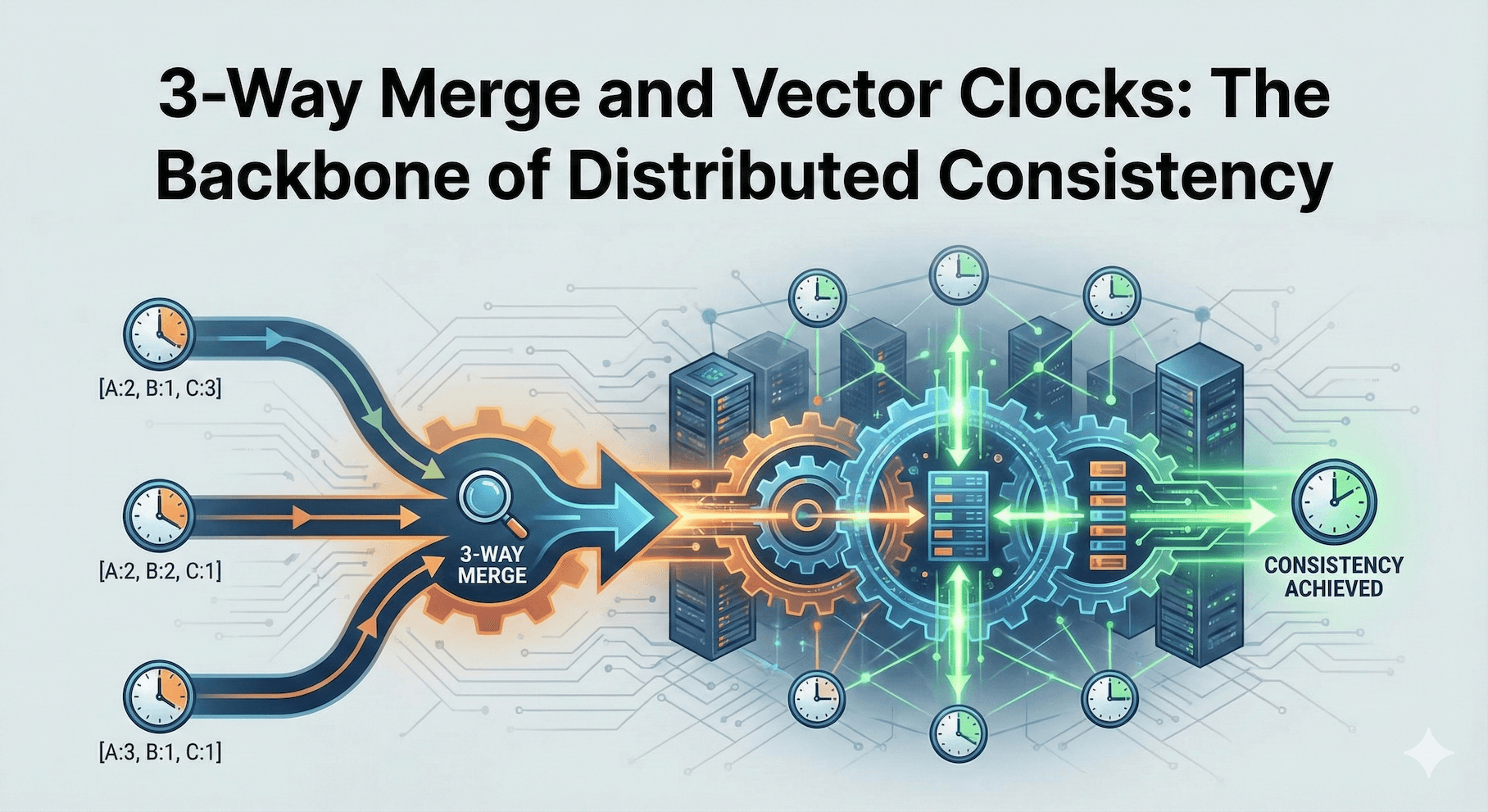
Every time you run git merge, resolve a conflict in Google Docs, or watch your notes sync across devices in real-time, you're witnessing the magic of 3-way merge and vector clocks at work. These two concepts form the bedrock of modern distributed systems, enabling billions of devices to collaborate, synchronize, and maintain consistency without central coordination.
Yet, despite their ubiquity, these concepts remain poorly understood by most engineers. Today, we're going to change that.
The Problem: Distributed Systems Are Hard
Imagine you're building a collaborative text editor. Alice in New York edits line 5. Bob in Tokyo edits line 10. Carol in London deletes line 7. All three are working offline, and their changes need to merge seamlessly when they reconnect.
Timeline of Chaos:

Alice (NYC)     Bob (Tokyo)      Carol (London)
    |               |                |
    |  [Edit L5]    |                |
    |               |  [Edit L10]    |
    |               |                |  [Delete L7]
    |               |                |
    └───────────────┴────────────────┘
                    |
              How do we merge?
Without proper algorithms, you face:
- Lost updates - Someone's work gets silently overwritten
- False conflicts - Non-conflicting changes flagged as conflicts
- Inconsistent state - Different users see different "final" versions
- Causality violations - Effects appearing before their causes
This is where vector clocks and 3-way merge come to the rescue.
Part 1: Vector Clocks - Tracking Causality in Distributed Systems
What Are Vector Clocks?
A vector clock is a mechanism for tracking the partial ordering of events in a distributed system. Unlike wall-clock time (which can drift, skew, or be manipulated), vector clocks capture the causal relationship between events.
The key insight: In distributed systems, we don't need to know the exact time something happened. We need to know what happened before what.
The Fundamental Structure
A vector clock is simply a map from node IDs to logical timestamps:
VectorClock = {
  node_A: 3,
  node_B: 2,
  node_C: 5
}
Each entry represents: "This is the latest event I know about from this node."
The Three Rules of Vector Clocks
Rule 1: Local Event → Increment
When a node performs a local operation, it increments its own counter:
def local_event(node_id, vector_clock):
    vector_clock[node_id] = vector_clock.get(node_id, 0) + 1
    return vector_clock
Rule 2: Send Message → Increment + Attach
When sending a message, increment your counter and attach the vector clock:
def send_message(node_id, vector_clock, message):
    vector_clock[node_id] = vector_clock.get(node_id, 0) + 1
    return Message(
        payload=message,
        vector_clock=vector_clock.copy()
    )
Rule 3: Receive Message → Merge + Increment
When receiving a message, merge clocks (taking max of each entry) and increment:
def receive_message(node_id, local_clock, received_message):
    received_clock = received_message.vector_clock

    # Merge: take maximum of each component
    merged = {}
    all_nodes = set(local_clock.keys()) | set(received_clock.keys())

    for node in all_nodes:
        merged[node] = max(
            local_clock.get(node, 0),
            received_clock.get(node, 0)
        )

    # Increment own counter
    merged[node_id] = merged.get(node_id, 0) + 1

    return merged
Visual Example: Vector Clocks in Action
Let's trace through a real scenario with three nodes:
Node A              Node B              Node C
  |                   |                   |
  | {A:1}             |                   |
  |----[msg1]-------->|                   |
  |                   | {A:1,B:1}         |
  |                   |----[msg2]-------->|
  |                   |                   | {A:1,B:1,C:1}
  | {A:2}             |                   |
  |                   | {A:1,B:2}         |
  |                   |                   |
  |<-----------------[msg3]---------------|
  | {A:3,B:1,C:1}     |                   | {A:1,B:1,C:2}
  |                   |                   |
Step-by-step breakdown:
- A performs local event:
{A:1} - A sends msg1 to B: A's clock stays
{A:1}, B receives and merges to{A:1,B:1} - B sends msg2 to C: C merges to
{A:1,B:1,C:1} - A performs another local event:
{A:2} - B performs local event:
{A:1,B:2} - C sends msg3 to A: A merges to
{A:3,B:1,C:1}(note: A takes max, so B stays at 1 since that's what C knew) - C performs local event:
{A:1,B:1,C:2}
Comparing Vector Clocks: The Power of Partial Ordering
Given two vector clocks V1 and V2, exactly one of four relationships holds:
def compare_vector_clocks(v1, v2):
    all_nodes = set(v1.keys()) | set(v2.keys())

    v1_greater = False
    v2_greater = False

    for node in all_nodes:
        val1 = v1.get(node, 0)
        val2 = v2.get(node, 0)

        if val1 > val2:
            v1_greater = True
        elif val2 > val1:
            v2_greater = True

    if v1_greater and not v2_greater:
        return "V1 HAPPENED_AFTER V2"  # V1 > V2
    elif v2_greater and not v1_greater:
        return "V1 HAPPENED_BEFORE V2"  # V1 < V2
    elif not v1_greater and not v2_greater:
        return "V1 EQUALS V2"  # V1 == V2
    else:
        return "CONCURRENT"  # V1 || V2 (conflict!)
The four relationships:
| Relationship | Meaning | Example |
|---|---|---|
V1 < V2 | V1 happened before V2 | {A:1,B:2} < {A:2,B:3} |
V1 > V2 | V1 happened after V2 | {A:3,B:3} > {A:2,B:2} |
V1 == V2 | Same event | {A:2,B:1} == {A:2,B:1} |
V1 || V2 | Concurrent (conflict!) | {A:2,B:1} || {A:1,B:2} |
The magic: When clocks are concurrent, we've detected a potential conflict that needs resolution!
Why Not Just Use Timestamps?
Wall-clock time fails in distributed systems for several reasons:
The Timestamp Problem:

Server A (Clock: 10:00:00.000)    Server B (Clock: 10:00:00.050)
         |                                    |
    [Write X=1]                          [Write X=2]
    T=10:00:00.001                       T=10:00:00.002
         |                                    |
         └──────────── Which wins? ───────────┘

Problem: Server B's clock is 50ms ahead!
Reality: A's write might have happened AFTER B's write
         but appears to have happened before.
Issues with wall-clock time:
- Clock drift: Hardware clocks drift ~10-100 ppm
- Clock skew: Different machines have different times
- NTP corrections: Time can jump forward or backward
- Leap seconds: Time isn't monotonic
- No causality: Timestamps don't capture "happened-before"
Vector clocks solve all of this by tracking logical time based on observed events.
Part 2: 3-Way Merge - The Art of Conflict Resolution
What Is 3-Way Merge?
A 3-way merge is an algorithm that combines two divergent versions of something by comparing them against their common ancestor. Unlike a 2-way merge (which can only compare two versions), 3-way merge can determine what actually changed and who changed it.
              [Common Ancestor]
                    |
         ┌─────────┴─────────┐
         |                   |
         v                   v
    [Version A]         [Version B]
         |                   |
         └─────────┬─────────┘
                   |
                   v
            [Merged Result]
Why "3-Way"?
The three "ways" refer to the three inputs:
- Base (Ancestor): The original version before divergence
- Ours (Local): Our modified version
- Theirs (Remote): Their modified version
The 3-Way Merge Algorithm
Here's the core logic:
def three_way_merge(base, ours, theirs):
    """
    Merge two divergent versions using their common ancestor.

    Returns: (merged_result, conflicts)
    """
    result = []
    conflicts = []

    # For each element/line/chunk:
    for i in range(max(len(base), len(ours), len(theirs))):
        base_val = base[i] if i < len(base) else None
        our_val = ours[i] if i < len(ours) else None
        their_val = theirs[i] if i < len(theirs) else None

        if our_val == their_val:
            # Both made same change (or no change) - easy!
            result.append(our_val)

        elif our_val == base_val:
            # We didn't change it, they did - take theirs
            result.append(their_val)

        elif their_val == base_val:
            # They didn't change it, we did - take ours
            result.append(our_val)

        else:
            # Both changed differently from base - CONFLICT!
            conflicts.append({
                'position': i,
                'base': base_val,
                'ours': our_val,
                'theirs': their_val
            })
            result.append(f"<<<CONFLICT at {i}>>>")

    return result, conflicts
Visual Example: 3-Way Merge in Action
Let's merge two versions of a configuration file:
# BASE (Common Ancestor)
database:
  host: localhost
  port: 5432
  pool_size: 10
cache:
  enabled: true
  ttl: 3600
# OURS (Local Changes)
database:
  host: localhost
  port: 5432
  pool_size: 20        # Changed: 10 → 20
cache:
  enabled: true
  ttl: 3600
logging:                # Added new section
  level: INFO
# THEIRS (Remote Changes)
database:
  host: db.prod.com    # Changed: localhost → db.prod.com
  port: 5432
  pool_size: 10
cache:
  enabled: false       # Changed: true → false
  ttl: 3600
3-Way Merge Analysis:
| Field | Base | Ours | Theirs | Result | Reasoning |
|---|---|---|---|---|---|
database.host | localhost | localhost | db.prod.com | db.prod.com | We didn't change, they did |
database.port | 5432 | 5432 | 5432 | 5432 | Nobody changed |
database.pool_size | 10 | 20 | 10 | 20 | We changed, they didn't |
cache.enabled | true | true | false | false | We didn't change, they did |
cache.ttl | 3600 | 3600 | 3600 | 3600 | Nobody changed |
logging | ∅ | {level:INFO} | ∅ | {level:INFO} | We added, they didn't |
Merged Result:
database:
  host: db.prod.com    # From theirs
  port: 5432
  pool_size: 20        # From ours
cache:
  enabled: false       # From theirs
  ttl: 3600
logging:               # From ours
  level: INFO
No conflicts! The 3-way merge algorithm automatically resolved everything because changes didn't overlap.
When Conflicts Occur
Conflicts happen when both sides modified the same thing differently:
# BASE
timeout: 30

# OURS
timeout: 60    # We increased it

# THEIRS
timeout: 15    # They decreased it
Result: CONFLICT!
<<<<<<< OURS
timeout: 60
=======
timeout: 15
>>>>>>> THEIRS
The algorithm cannot automatically decide which value is correct. A human (or application-specific logic) must resolve it.
The Power of Having a Common Ancestor
Without the base (2-way merge), we'd have many more "false conflicts":
2-Way Merge (No Base):

OURS:   timeout: 60
THEIRS: timeout: 60

Are these the same because:
  a) Neither changed it (it was always 60)
  b) Both independently changed it to 60
  c) One changed it, one didn't

We can't tell! Must flag as potential conflict.
3-Way Merge (With Base):

BASE:   timeout: 30
OURS:   timeout: 60
THEIRS: timeout: 60

Now we know: Both changed 30 → 60
Result: Take 60, no conflict (convergent change)
Part 3: Vector Clocks + 3-Way Merge = Distributed Consistency
The Marriage of Two Concepts
Vector clocks and 3-way merge work together beautifully:
- Vector clocks identify WHEN conflicts occur (concurrent modifications)
- 3-way merge resolves HOW to merge (using common ancestor)
┌─────────────────────────────────────────────────────────────┐
│                    DISTRIBUTED MERGE FLOW                    │
├─────────────────────────────────────────────────────────────┤
│                                                              │
│   [Event A]              [Event B]                           │
│   VC: {A:3,B:2}          VC: {A:2,B:4}                       │
│        │                      │                              │
│        └──────────┬───────────┘                              │
│                   │                                          │
│          Compare Vector Clocks                               │
│                   │                                          │
│         ┌────────┴────────┐                                  │
│         │                 │                                  │
│    [Ordered]        [Concurrent]                             │
│         │                 │                                  │
│   Take later         Find LCA using                          │
│    version           version DAG                             │
│         │                 │                                  │
│         │           3-Way Merge                              │
│         │          /     |     \                             │
│         │       Base   Ours   Theirs                         │
│         │          \     |     /                             │
│         └──────────┬────┴────┬──────────────────────────     │
│                    │         │                               │
│              [No Conflict] [Conflict]                        │
│                    │         │                               │
│              Auto-merge   Manual/                            │
│                          App-specific                        │
│                          resolution                          │
└─────────────────────────────────────────────────────────────┘
Finding the Lowest Common Ancestor (LCA)
For 3-way merge to work, we need to find the common ancestor. In a version DAG (Directed Acyclic Graph), this is the Lowest Common Ancestor (LCA):
def find_lca(version_a, version_b, version_graph):
    """
    Find the Lowest Common Ancestor of two versions.

    The version_graph maps each version to its parent(s).
    """
    # Get all ancestors of A
    ancestors_a = set()
    queue = [version_a]
    while queue:
        current = queue.pop(0)
        if current in ancestors_a:
            continue
        ancestors_a.add(current)
        queue.extend(version_graph.get(current, {}).get('parents', []))

    # BFS from B to find first common ancestor
    queue = [version_b]
    visited = set()
    while queue:
        current = queue.pop(0)
        if current in visited:
            continue
        visited.add(current)

        if current in ancestors_a:
            return current  # Found LCA!

        queue.extend(version_graph.get(current, {}).get('parents', []))

    return None  # No common ancestor (shouldn't happen in well-formed DAG)
Real Implementation: A Distributed Key-Value Store
Let's build a simple distributed KV store that uses both concepts:
import hashlib
import json
from dataclasses import dataclass, field
from typing import Dict, List, Optional, Any
from enum import Enum

class ConflictResolution(Enum):
    LAST_WRITE_WINS = "lww"
    FIRST_WRITE_WINS = "fww"
    MANUAL = "manual"
    MERGE_VALUES = "merge"

@dataclass
class Version:
    """A versioned value with vector clock."""
    value: Any
    vector_clock: Dict[str, int]
    node_id: str
    timestamp: float  # Wall clock for LWW fallback

    def to_hash(self) -> str:
        """Generate unique hash for this version."""
        content = json.dumps({
            'value': self.value,
            'vc': sorted(self.vector_clock.items())
        }, sort_keys=True)
        return hashlib.sha256(content.encode()).hexdigest()[:12]

@dataclass
class VersionedValue:
    """A value that may have multiple concurrent versions."""
    key: str
    versions: List[Version] = field(default_factory=list)

    def add_version(self, version: Version):
        """Add a new version, pruning dominated versions."""
        dominated = []
        dominated_by_new = False

        for existing in self.versions:
            cmp = compare_vector_clocks(existing.vector_clock, version.vector_clock)

            if cmp == "HAPPENED_BEFORE":
                # Existing is older, mark for removal
                dominated.append(existing)
            elif cmp == "HAPPENED_AFTER":
                # New version is older, don't add it
                dominated_by_new = True
                break
            elif cmp == "EQUALS":
                # Same version, skip
                dominated_by_new = True
                break
            # If CONCURRENT, keep both

        if not dominated_by_new:
            # Remove dominated versions
            self.versions = [v for v in self.versions if v not in dominated]
            self.versions.append(version)

    def has_conflicts(self) -> bool:
        """Check if there are concurrent versions (conflicts)."""
        return len(self.versions) > 1

    def get_value(self, resolution: ConflictResolution = ConflictResolution.LAST_WRITE_WINS):
        """Get the value, resolving conflicts if necessary."""
        if not self.versions:
            return None

        if len(self.versions) == 1:
            return self.versions[0].value

        # Multiple versions - need to resolve
        if resolution == ConflictResolution.LAST_WRITE_WINS:
            return max(self.versions, key=lambda v: v.timestamp).value
        elif resolution == ConflictResolution.FIRST_WRITE_WINS:
            return min(self.versions, key=lambda v: v.timestamp).value
        elif resolution == ConflictResolution.MANUAL:
            raise ConflictError(f"Key {self.key} has conflicts", self.versions)
        elif resolution == ConflictResolution.MERGE_VALUES:
            return self._merge_values()

    def _merge_values(self) -> Any:
        """Attempt automatic merge of conflicting values."""
        # For sets/lists, take union
        if all(isinstance(v.value, (list, set)) for v in self.versions):
            merged = set()
            for v in self.versions:
                merged.update(v.value)
            return list(merged)

        # For dicts, do 3-way merge
        if all(isinstance(v.value, dict) for v in self.versions):
            return self._three_way_dict_merge()

        # Can't auto-merge, fall back to LWW
        return max(self.versions, key=lambda v: v.timestamp).value

    def _three_way_dict_merge(self) -> dict:
        """
        Perform 3-way merge on dictionary values.
        Uses empty dict as base if no common ancestor available.
        """
        # Simplified: use empty dict as base
        # In real implementation, would find LCA
        base = {}

        # Start with base
        result = base.copy()
        conflicts = {}

        all_keys = set()
        for v in self.versions:
            all_keys.update(v.value.keys())

        for key in all_keys:
            values = []
            for v in self.versions:
                values.append(v.value.get(key))

            unique_values = list(set(str(v) for v in values))

            if len(unique_values) == 1:
                # All agree
                result[key] = self.versions[0].value.get(key)
            else:
                # Conflict on this key - take most recent
                latest = max(self.versions, key=lambda v: v.timestamp)
                result[key] = latest.value.get(key)
                conflicts[key] = values

        return result


class ConflictError(Exception):
    """Raised when manual conflict resolution is required."""
    def __init__(self, message, versions):
        super().__init__(message)
        self.versions = versions


def compare_vector_clocks(v1: Dict[str, int], v2: Dict[str, int]) -> str:
    """Compare two vector clocks and return their relationship."""
    all_nodes = set(v1.keys()) | set(v2.keys())

    v1_greater = False
    v2_greater = False

    for node in all_nodes:
        val1 = v1.get(node, 0)
        val2 = v2.get(node, 0)

        if val1 > val2:
            v1_greater = True
        elif val2 > val1:
            v2_greater = True

    if v1_greater and not v2_greater:
        return "HAPPENED_AFTER"
    elif v2_greater and not v1_greater:
        return "HAPPENED_BEFORE"
    elif not v1_greater and not v2_greater:
        return "EQUALS"
    else:
        return "CONCURRENT"


class DistributedKVStore:
    """A distributed key-value store using vector clocks."""

    def __init__(self, node_id: str):
        self.node_id = node_id
        self.vector_clock: Dict[str, int] = {}
        self.data: Dict[str, VersionedValue] = {}

    def _increment_clock(self):
        """Increment this node's logical clock."""
        self.vector_clock[self.node_id] = self.vector_clock.get(self.node_id, 0) + 1

    def _merge_clock(self, other_clock: Dict[str, int]):
        """Merge another vector clock into ours."""
        all_nodes = set(self.vector_clock.keys()) | set(other_clock.keys())
        for node in all_nodes:
            self.vector_clock[node] = max(
                self.vector_clock.get(node, 0),
                other_clock.get(node, 0)
            )

    def put(self, key: str, value: Any, context: Optional[Dict[str, int]] = None):
        """
        Write a value with optional causal context.

        If context is provided, it represents the version being updated.
        """
        import time

        # Merge context if provided (read-your-writes)
        if context:
            self._merge_clock(context)

        self._increment_clock()

        version = Version(
            value=value,
            vector_clock=self.vector_clock.copy(),
            node_id=self.node_id,
            timestamp=time.time()
        )

        if key not in self.data:
            self.data[key] = VersionedValue(key=key)

        self.data[key].add_version(version)

        return self.vector_clock.copy()

    def get(self, key: str, resolution: ConflictResolution = ConflictResolution.LAST_WRITE_WINS):
        """
        Read a value with conflict resolution strategy.

        Returns (value, context, has_conflicts)
        """
        if key not in self.data:
            return None, {}, False

        vv = self.data[key]
        value = vv.get_value(resolution)

        # Build context from all versions' clocks
        context = {}
        for version in vv.versions:
            for node, clock in version.vector_clock.items():
                context[node] = max(context.get(node, 0), clock)

        return value, context, vv.has_conflicts()

    def sync_from(self, other: 'DistributedKVStore'):
        """Sync data from another node."""
        self._merge_clock(other.vector_clock)

        for key, other_vv in other.data.items():
            if key not in self.data:
                self.data[key] = VersionedValue(key=key)

            for version in other_vv.versions:
                self.data[key].add_version(version)

        self._increment_clock()


# Demo usage
def demo():
    """Demonstrate vector clocks and conflict resolution."""

    # Create three nodes
    node_a = DistributedKVStore("node_a")
    node_b = DistributedKVStore("node_b")
    node_c = DistributedKVStore("node_c")

    print("=" * 60)
    print("DISTRIBUTED KV STORE DEMO")
    print("=" * 60)

    # Scenario 1: Sequential updates (no conflict)
    print("\n--- Scenario 1: Sequential Updates ---")
    ctx = node_a.put("user:1", {"name": "Alice", "age": 30})
    print(f"Node A writes user:1 -> Context: {ctx}")

    # Sync to B
    node_b.sync_from(node_a)

    # B updates with context
    value, ctx, _ = node_b.get("user:1")
    ctx = node_b.put("user:1", {"name": "Alice", "age": 31}, context=ctx)
    print(f"Node B updates user:1 (age: 31) -> Context: {ctx}")

    # Sync back to A
    node_a.sync_from(node_b)
    value, ctx, conflicts = node_a.get("user:1")
    print(f"Node A reads user:1 -> {value}, Conflicts: {conflicts}")

    # Scenario 2: Concurrent updates (conflict!)
    print("\n--- Scenario 2: Concurrent Updates (Conflict) ---")

    # Reset
    node_a = DistributedKVStore("node_a")
    node_b = DistributedKVStore("node_b")

    # A writes
    node_a.put("config", {"timeout": 30})
    # B writes independently (no sync)
    node_b.put("config", {"timeout": 60})

    print(f"Node A writes config.timeout=30")
    print(f"Node B writes config.timeout=60 (independently)")

    # Now sync
    node_a.sync_from(node_b)

    value, ctx, conflicts = node_a.get("config")
    print(f"After sync - Value: {value}, Has Conflicts: {conflicts}")
    print(f"Node A's versions: {len(node_a.data['config'].versions)}")

    # Scenario 3: Conflict resolution with merge
    print("\n--- Scenario 3: Dict Merge Resolution ---")

    node_a = DistributedKVStore("node_a")
    node_b = DistributedKVStore("node_b")

    # A writes some fields
    node_a.put("settings", {"theme": "dark", "lang": "en"})
    # B writes different fields
    node_b.put("settings", {"timezone": "UTC", "lang": "en"})

    node_a.sync_from(node_b)

    value, _, conflicts = node_a.get("settings", ConflictResolution.MERGE_VALUES)
    print(f"Merged settings: {value}")
    print(f"(Combined fields from both concurrent writes)")


if __name__ == "__main__":
    demo()
Output:
============================================================
DISTRIBUTED KV STORE DEMO
============================================================

--- Scenario 1: Sequential Updates ---
Node A writes user:1 -> Context: {'node_a': 1}
Node B updates user:1 (age: 31) -> Context: {'node_a': 1, 'node_b': 2}
Node A reads user:1 -> {'name': 'Alice', 'age': 31}, Conflicts: False

--- Scenario 2: Concurrent Updates (Conflict) ---
Node A writes config.timeout=30
Node B writes config.timeout=60 (independently)
After sync - Value: 60, Has Conflicts: True
Node A's versions: 2

--- Scenario 3: Dict Merge Resolution ---
Merged settings: {'theme': 'dark', 'lang': 'en', 'timezone': 'UTC'}
(Combined fields from both concurrent writes)
Part 4: Real-World Applications
1. Git: The 3-Way Merge Master
Git is perhaps the most famous user of 3-way merge. Every git merge operation:
# What happens when you run:
git merge feature-branch

# Git performs:
# 1. Find LCA (merge-base) of HEAD and feature-branch
# 2. 3-way merge: (merge-base, HEAD, feature-branch)
# 3. Auto-resolve non-conflicting changes
# 4. Mark conflicts for manual resolution
Git's merge-base algorithm:
# Find the common ancestor
$ git merge-base main feature
a1b2c3d4e5f6...

# View the three versions
$ git show a1b2c3d:file.txt    # Base
$ git show main:file.txt        # Ours
$ git show feature:file.txt     # Theirs
Git internally uses a variant of vector clocks through its DAG of commits, where each commit references its parent(s), creating a partial order.
2. Amazon Dynamo / Apache Cassandra: Vector Clocks at Scale
Amazon's Dynamo (and its open-source successors like Cassandra and Riak) use vector clocks for conflict detection:
Dynamo Write Flow:

Client                 Coordinator              Replicas (N=3)
   |                       |                         |
   |--- PUT(key,value) --->|                         |
   |                       |--- Write + VC --------->| R1
   |                       |--- Write + VC --------->| R2
   |                       |--- Write + VC --------->| R3
   |                       |                         |
   |                       |<-- ACK (W=2) -----------|
   |<-- Context (VC) ------|                         |
   |                       |                         |

Read Repair:
   |--- GET(key) --------->|                         |
   |                       |--- Read --------------->| R1: VC={A:1}
   |                       |--- Read --------------->| R2: VC={A:1}
   |                       |--- Read --------------->| R3: VC={B:1} ← Stale!
   |                       |                         |
   |                       | Compare VCs:            |
   |                       | R1,R2 > R3 → Repair R3  |
   |                       |                         |
   |<-- Value + VC --------|                         |
Cassandra's approach: Uses timestamps (not vector clocks) for simplicity, with Last-Write-Wins semantics. Trade-off: simpler but can lose concurrent writes.
Riak's approach: Full vector clocks with sibling resolution (returns all concurrent values to client).
3. Google Docs / Operational Transformation
Google Docs uses Operational Transformation (OT) which shares principles with 3-way merge:
Alice types "Hello" at position 0
Bob types "World" at position 0 (concurrently)

Without transformation:
  Alice sees: "HelloWorld"
  Bob sees: "WorldHello"
  ❌ Inconsistent!

With OT:
  Transform Bob's operation based on Alice's:
  Bob's insert(0, "World") → insert(5, "World")

  Both see: "HelloWorld"
  ✓ Consistent!
Modern alternatives like CRDTs (Conflict-free Replicated Data Types) achieve similar results with different trade-offs.
4. CRDTs: Merge Without Coordination
CRDTs are data structures designed to always merge without conflicts:
# G-Counter (Grow-only Counter) - A simple CRDT
class GCounter:
    """
    A CRDT counter that only grows.
    Uses vector clock-like structure internally.
    """
    def __init__(self, node_id: str):
        self.node_id = node_id
        self.counts: Dict[str, int] = {}

    def increment(self):
        self.counts[self.node_id] = self.counts.get(self.node_id, 0) + 1

    def value(self) -> int:
        return sum(self.counts.values())

    def merge(self, other: 'GCounter'):
        """Merge is always conflict-free!"""
        all_nodes = set(self.counts.keys()) | set(other.counts.keys())
        for node in all_nodes:
            self.counts[node] = max(
                self.counts.get(node, 0),
                other.counts.get(node, 0)
            )


# LWW-Register (Last-Writer-Wins Register)
@dataclass
class LWWRegister:
    """
    A register where concurrent writes resolve via timestamp.
    """
    value: Any = None
    timestamp: float = 0.0

    def set(self, value: Any, timestamp: float):
        if timestamp > self.timestamp:
            self.value = value
            self.timestamp = timestamp

    def merge(self, other: 'LWWRegister'):
        if other.timestamp > self.timestamp:
            self.value = other.value
            self.timestamp = other.timestamp


# OR-Set (Observed-Remove Set) - Add/Remove without conflicts
class ORSet:
    """
    A set CRDT that supports both add and remove.
    Each element tagged with unique ID to handle add/remove conflicts.
    """
    def __init__(self):
        self.elements: Dict[Any, Set[str]] = {}  # value -> set of unique tags
        self.tombstones: Dict[Any, Set[str]] = {}  # removed tags

    def add(self, element: Any):
        import uuid
        tag = str(uuid.uuid4())
        if element not in self.elements:
            self.elements[element] = set()
        self.elements[element].add(tag)

    def remove(self, element: Any):
        if element in self.elements:
            # Move all tags to tombstones
            if element not in self.tombstones:
                self.tombstones[element] = set()
            self.tombstones[element].update(self.elements[element])
            self.elements[element] = set()

    def contains(self, element: Any) -> bool:
        if element not in self.elements:
            return False
        # Element exists if it has tags not in tombstones
        active_tags = self.elements[element] - self.tombstones.get(element, set())
        return len(active_tags) > 0

    def merge(self, other: 'ORSet'):
        # Merge elements (union of tags)
        for elem, tags in other.elements.items():
            if elem not in self.elements:
                self.elements[elem] = set()
            self.elements[elem].update(tags)

        # Merge tombstones (union)
        for elem, tags in other.tombstones.items():
            if elem not in self.tombstones:
                self.tombstones[elem] = set()
            self.tombstones[elem].update(tags)
5. Distributed Databases Comparison
| Database | Conflict Detection | Conflict Resolution | Trade-off |
|---|---|---|---|
| Riak | Vector Clocks | Siblings (client resolves) | Most flexible, complex client |
| Cassandra | Timestamps | Last-Write-Wins | Simple, can lose data |
| CockroachDB | Hybrid Logical Clocks | Serializable isolation | Strong consistency, higher latency |
| DynamoDB | Conditional writes | Optimistic locking | Simple, requires retries |
| MongoDB | Oplog timestamps | Last-Write-Wins per doc | Simple, eventual consistency |
| Spanner | TrueTime (atomic clocks) | Global serialization | Strongest, requires special hardware |
Part 5: Advanced Topics
Hybrid Logical Clocks (HLC)
Vector clocks have a problem: they grow with the number of nodes. Hybrid Logical Clocks combine physical time with logical counters:
@dataclass
class HybridLogicalClock:
    """
    Combines wall-clock time with logical counter.
    Provides bounded size while maintaining causality.
    """
    wall_time: int  # Physical timestamp (milliseconds)
    logical: int    # Logical counter for same wall_time

    def __init__(self):
        self.wall_time = self._now()
        self.logical = 0

    def _now(self) -> int:
        import time
        return int(time.time() * 1000)

    def tick(self) -> 'HybridLogicalClock':
        """Local event."""
        now = self._now()
        if now > self.wall_time:
            self.wall_time = now
            self.logical = 0
        else:
            self.logical += 1
        return self

    def receive(self, other: 'HybridLogicalClock') -> 'HybridLogicalClock':
        """Receive event from another node."""
        now = self._now()

        if now > self.wall_time and now > other.wall_time:
            self.wall_time = now
            self.logical = 0
        elif self.wall_time == other.wall_time:
            self.logical = max(self.logical, other.logical) + 1
        elif self.wall_time > other.wall_time:
            self.logical += 1
        else:
            self.wall_time = other.wall_time
            self.logical = other.logical + 1

        return self

    def __lt__(self, other: 'HybridLogicalClock') -> bool:
        if self.wall_time != other.wall_time:
            return self.wall_time < other.wall_time
        return self.logical < other.logical

    def __repr__(self):
        return f"HLC({self.wall_time}.{self.logical})"
Benefits of HLC:
- Fixed size (just 2 numbers) vs growing vector clocks
- Bounded drift from real time
- Still captures causality
- Used by CockroachDB, MongoDB, and others
Dotted Version Vectors
An optimization over vector clocks that reduces sibling explosion:
@dataclass
class DottedVersionVector:
    """
    Optimized version vector that tracks:
    - version_vector: What we've seen from each node
    - dot: The specific (node, counter) that created this value
    """
    version_vector: Dict[str, int]
    dot: tuple  # (node_id, counter)

    def dominates(self, other: 'DottedVersionVector') -> bool:
        """Check if this DVV dominates (is newer than) another."""
        other_node, other_counter = other.dot
        return self.version_vector.get(other_node, 0) >= other_counter

    def concurrent_with(self, other: 'DottedVersionVector') -> bool:
        """Check if two DVVs are concurrent (neither dominates)."""
        return not self.dominates(other) and not other.dominates(self)
Interval Tree Clocks
For highly dynamic systems where nodes join and leave frequently:
Traditional Vector Clock problem:
- 1000 nodes = 1000 entries in every clock
- Nodes that leave still take up space

Interval Tree Clocks solution:
- Use intervals [0,1] instead of discrete node IDs
- Nodes "own" portions of the interval
- Can split/join without coordination
- Space proportional to active nodes only
Part 6: Implementation Patterns and Best Practices
Pattern 1: Read-Your-Writes with Vector Clocks
class SessionConsistentClient:
    """
    Client that ensures read-your-writes consistency
    by tracking vector clock context.
    """
    def __init__(self, store: DistributedKVStore):
        self.store = store
        self.session_context: Dict[str, int] = {}

    def write(self, key: str, value: Any):
        # Include session context to ensure causality
        new_context = self.store.put(key, value, context=self.session_context)
        # Update session context
        self._merge_context(new_context)

    def read(self, key: str) -> Any:
        value, context, _ = self.store.get(key)
        # Update session context
        self._merge_context(context)
        return value

    def _merge_context(self, new_context: Dict[str, int]):
        for node, clock in new_context.items():
            self.session_context[node] = max(
                self.session_context.get(node, 0),
                clock
            )
Pattern 2: Crujdt Resolution Strategies
class ConflictResolver:
    """Pluggable conflict resolution strategies."""

    @staticmethod
    def last_write_wins(versions: List[Version]) -> Version:
        return max(versions, key=lambda v: v.timestamp)

    @staticmethod
    def first_write_wins(versions: List[Version]) -> Version:
        return min(versions, key=lambda v: v.timestamp)

    @staticmethod
    def highest_value(versions: List[Version]) -> Version:
        """For numeric values, take the highest."""
        return max(versions, key=lambda v: v.value)

    @staticmethod
    def merge_sets(versions: List[Version]) -> Any:
        """For set values, take union."""
        result = set()
        for v in versions:
            if isinstance(v.value, (list, set)):
                result.update(v.value)
        return result

    @staticmethod
    def application_specific(versions: List[Version], resolver_fn) -> Any:
        """Custom application logic."""
        return resolver_fn(versions)
Pattern 3: Merkle Trees for Efficient Sync
class MerkleTree:
    """
    Hash tree for efficient comparison of large datasets.
    Used by Dynamo, Cassandra, etc. for anti-entropy.
    """
    def __init__(self, data: Dict[str, Any]):
        self.leaves = {}
        self.root = self._build(data)

    def _hash(self, content: str) -> str:
        return hashlib.sha256(content.encode()).hexdigest()[:16]

    def _build(self, data: Dict[str, Any]) -> str:
        if not data:
            return self._hash("")

        # Sort keys for deterministic ordering
        sorted_keys = sorted(data.keys())

        # Hash each key-value pair
        for key in sorted_keys:
            value_hash = self._hash(str(data[key]))
            self.leaves[key] = value_hash

        # Build tree bottom-up
        level = list(self.leaves.values())
        while len(level) > 1:
            next_level = []
            for i in range(0, len(level), 2):
                left = level[i]
                right = level[i + 1] if i + 1 < len(level) else ""
                next_level.append(self._hash(left + right))
            level = next_level

        return level[0] if level else self._hash("")

    def diff(self, other: 'MerkleTree') -> List[str]:
        """Find keys that differ between two trees."""
        if self.root == other.root:
            return []  # Identical!

        # Find differing leaves
        diffs = []
        all_keys = set(self.leaves.keys()) | set(other.leaves.keys())

        for key in all_keys:
            if self.leaves.get(key) != other.leaves.get(key):
                diffs.append(key)

        return diffs
Key Takeaways
When to Use Vector Clocks
✅ Use vector clocks when:
- You need to detect concurrent modifications
- Causality matters (e.g., "reply must come after message")
- You want flexibility in conflict resolution
- System has bounded number of writers
❌ Avoid vector clocks when:
- Simple last-write-wins is acceptable
- System has unbounded/dynamic nodes (use HLC instead)
- Strong consistency is required (use consensus protocols)
When to Use 3-Way Merge
✅ Use 3-way merge when:
- You can identify a common ancestor
- Content is structured (text lines, config fields, objects)
- Auto-resolution of non-conflicting changes is valuable
- Users can handle manual conflict resolution
❌ Avoid 3-way merge when:
- No common ancestor exists
- Content is opaque binary data
- Real-time collaboration required (use OT/CRDT instead)
Design Principles
- Capture causality, not wall-clock time - Vector clocks tell you what happened before what
- Design for conflict resolution - Conflicts will happen; plan for them
- Use the right tool - LWW for simplicity, vector clocks for correctness, CRDTs for automatic merge
- Keep context - Pass version context through read/write cycles
- Bound your metadata - Vector clocks grow; consider HLC for large systems
Conclusion
Vector clocks and 3-way merge are fundamental algorithms that power the distributed systems we use every day. From Git's elegant merge system to the conflict resolution in distributed databases, these concepts enable billions of devices to collaborate while maintaining consistency.
Understanding these algorithms deeply transforms how you think about distributed systems:
- Conflicts aren't errors - they're expected outcomes that need resolution strategies
- Time is relative - logical ordering matters more than wall-clock time
- Common ancestors are powerful - they enable intelligent, automatic merging
The next time you run git merge or watch your notes sync across devices, you'll know the elegant mathematics happening under the hood.
Want to discuss distributed systems, algorithms, or anything tech?