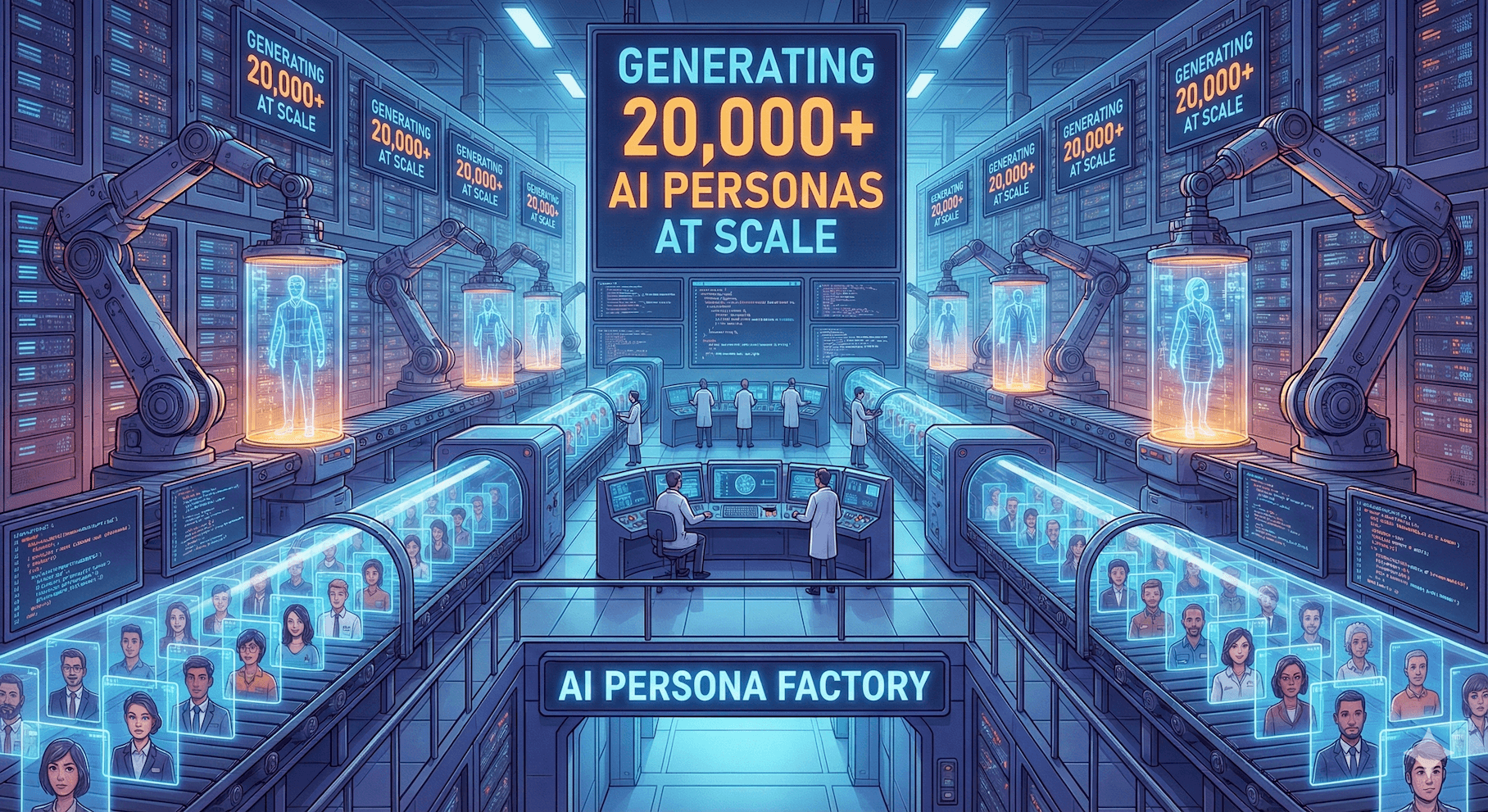
What if you could create 20,000 AI personas—each with unique personalities, specializations, communication styles, and domain knowledge—across hundreds of categories and dozens of languages?
This guide covers the complete technical architecture for building an agentic AI pipeline that can generate millions of content pieces, create thousands of unique personas, and scale to production efficiently.
The Challenge: AI Content at Global Scale
Consider these requirements for a large-scale AI persona system:
- 20,000 unique AI personas
- 100+ categories with deep specialization
- 100+ sub-categories for granular expertise
- 15-20 languages for global reach
- 1+ million translations for localized content
- Budget constraints requiring cost optimization
Traditional approaches would require:
- Months of manual content creation
- Teams of specialized translators
- Millions in development costs
An agentic pipeline can accomplish this in weeks at a fraction of the cost. Here's how.
The Architecture: An AI Factory
The Agentic Pipeline Overview
┌─────────────────────────────────────────────────────────────────────┐
│                        ORCHESTRATION LAYER                          │
│                    (LangGraph State Machine)                        │
└─────────────────────────────────────────────────────────────────────┘
                                  │
        ┌─────────────────────────┼─────────────────────────────┐
        │                         │                             │
        ▼                         ▼                             ▼
┌───────────────┐        ┌───────────────┐            ┌───────────────┐
│   CATEGORY    │        │    PERSONA    │            │  TRANSLATION  │
│   GENERATOR   │───────▶│   GENERATOR   │───────────▶│    ENGINE     │
│    AGENT      │        │    AGENT      │            │    AGENT      │
└───────────────┘        └───────────────┘            └───────────────┘
        │                         │                             │
        ▼                         ▼                             ▼
┌───────────────┐        ┌───────────────┐            ┌───────────────┐
│  VALIDATION   │        │   QUALITY     │            │   CULTURAL    │
│    AGENT      │        │   CONTROL     │            │  ADAPTATION   │
│               │        │    AGENT      │            │    AGENT      │
└───────────────┘        └───────────────┘            └───────────────┘
                                  │
                                  ▼
                    ┌───────────────────────┐
                    │     PERSISTENCE       │
                    │   (PostgreSQL + S3)   │
                    └───────────────────────┘
The Core Principle: Agents All the Way Down
Instead of monolithic prompts, specialized agents collaborate on different aspects of the task:
from langgraph.graph import StateGraph, END
from langchain_openai import ChatOpenAI
from typing import TypedDict, List

class PipelineState(TypedDict):
    category: str
    sub_categories: List[str]
    personas: List[dict]
    translations: dict
    validation_results: dict
    errors: List[str]

# Initialize the state graph
workflow = StateGraph(PipelineState)

# Add nodes (agents)
workflow.add_node("generate_subcategories", generate_subcategories_agent)
workflow.add_node("create_personas", create_personas_agent)
workflow.add_node("translate_content", translate_content_agent)
workflow.add_node("validate_content", validate_content_agent)
workflow.add_node("cultural_adapt", cultural_adaptation_agent)
workflow.add_node("quality_check", quality_check_agent)

# Define the flow
workflow.set_entry_point("generate_subcategories")
workflow.add_edge("generate_subcategories", "create_personas")
workflow.add_edge("create_personas", "translate_content")
workflow.add_edge("translate_content", "cultural_adapt")
workflow.add_edge("cultural_adapt", "validate_content")
workflow.add_conditional_edges(
    "validate_content",
    should_retry_or_continue,
    {
        "retry": "create_personas",
        "continue": "quality_check",
        "fail": END
    }
)
workflow.add_edge("quality_check", END)

# Compile the graph
pipeline = workflow.compile()
Deep Dive: The Agents
Agent 1: Category Generator
This agent takes a base category and generates comprehensive sub-category mappings:
class CategoryGeneratorAgent:
    def __init__(self):
        self.llm = ChatOpenAI(model="gpt-4-turbo", temperature=0.3)
        self.system_prompt = """You are a domain taxonomy expert.
        Given a category, generate a comprehensive list of:
        1. Sub-categories (specific areas of focus)
        2. Common topics covered
        3. Typical expertise areas
        4. Required knowledge domains

        Format as structured JSON. Be exhaustive and accurate."""

    async def generate(self, category: str) -> dict:
        messages = [
            SystemMessage(content=self.system_prompt),
            HumanMessage(content=f"Generate sub-category taxonomy for: {category}")
        ]

        response = await self.llm.ainvoke(messages)
        return self._parse_response(response.content)

    def _parse_response(self, content: str) -> dict:
        # Robust JSON parsing with fallbacks
        try:
            return json.loads(content)
        except json.JSONDecodeError:
            # Use regex extraction as fallback
            return self._extract_structured_data(content)
Sample Output:
{
  "category": "Healthcare",
  "sub_categories": [
    {
      "name": "Cardiology",
      "focus": "Heart and cardiovascular system",
      "topics": ["Heart disease", "Hypertension", "Cardiac procedures"],
      "expertise": ["ECG interpretation", "Interventional procedures", "Prevention"]
    },
    {
      "name": "Neurology",
      "focus": "Brain and nervous system disorders",
      "topics": ["Stroke", "Epilepsy", "Neurodegenerative diseases"],
      "expertise": ["Neuroimaging", "EEG analysis", "Movement disorders"]
    }
  ]
}
Agent 2: Persona Generator
The heart of the system—creating unique, believable AI personas:
class PersonaGeneratorAgent:
    def __init__(self):
        self.llm = ChatOpenAI(model="gpt-4-turbo", temperature=0.7)

    async def generate_persona(
        self,
        category: str,
        sub_category: str,
        persona_index: int
    ) -> dict:
        prompt = f"""Create a unique AI persona for:
        Category: {category}
        Sub-category: {sub_category}
        Persona Index: {persona_index} (use for variety)

        Generate:
        1. **Name**: Culturally appropriate, globally diverse
        2. **Background**: Education, training, experience (10-30 years)
        3. **Communication Style**: (Warm/Clinical/Empathetic/Direct)
        4. **Areas of Expertise**: 3-5 specific focus areas
        5. **Approach**: Philosophy and methods
        6. **Notable Achievements**: Research, publications, innovations
        7. **Personality Traits**: 3-4 distinctive characteristics
        8. **Voice Characteristics**: How they communicate

        Make each persona distinctly different. Avoid stereotypes.
        Return as structured JSON."""

        response = await self.llm.ainvoke([HumanMessage(content=prompt)])
        persona = json.loads(response.content)

        # Add computed fields
        persona["id"] = self._generate_id(category, sub_category, persona_index)
        persona["category"] = category
        persona["sub_category"] = sub_category

        return persona
Sample Persona Output:
{
  "id": "health-cardio-042",
  "name": "Dr. Priya Sharma",
  "category": "Healthcare",
  "sub_category": "Cardiology",
  "background": {
    "education": "Top medical school, specialized fellowship",
    "experience_years": 18,
    "current_role": "Director of Cardiac Care"
  },
  "communication_style": "Warm and methodical",
  "expertise_areas": [
    "Complex interventions",
    "Preventive cardiology",
    "Women's heart health",
    "Sports cardiology"
  ],
  "approach": "Believes in shared decision-making. Takes time to explain procedures using visual aids. Known for thorough explanations.",
  "achievements": [
    "Pioneer of minimally invasive techniques",
    "Published 45+ papers in peer-reviewed journals",
    "Trained 200+ specialists"
  ],
  "personality_traits": [
    "Calm under pressure",
    "Detail-oriented",
    "Encouraging",
    "Accessible"
  ],
  "voice_characteristics": {
    "tone": "Reassuring and confident",
    "pace": "Measured, never rushed",
    "vocabulary": "Uses simple analogies for complex concepts",
    "signature_phrases": [
      "Let me walk you through this step by step",
      "Your health is stronger than you think"
    ]
  }
}
Agent 3: Translation Engine
The most cost-intensive component—aggressive optimization is essential:
class TranslationAgent:
    def __init__(self):
        # Use GPT-3.5-turbo for translations (cost-effective)
        self.llm = ChatOpenAI(model="gpt-3.5-turbo-16k", temperature=0.2)
        self.batch_size = 50  # Translate in batches

    async def translate_batch(
        self,
        content_items: List[dict],
        target_language: str,
        context: str = "professional"
    ) -> List[dict]:
        """Translate a batch of content items efficiently."""

        prompt = f"""Translate the following content to {target_language}.

        Context: {context}

        CRITICAL REQUIREMENTS:
        1. Maintain accuracy - use proper terminology
        2. Preserve formatting and structure
        3. Adapt cultural references appropriately
        4. Keep proper nouns unchanged
        5. Use formal professional register

        Content to translate:
        {json.dumps(content_items, indent=2)}

        Return as JSON array with same structure, translated."""

        response = await self.llm.ainvoke([HumanMessage(content=prompt)])
        return json.loads(response.content)

    async def translate_persona(
        self,
        persona: dict,
        languages: List[str]
    ) -> dict:
        """Translate a complete persona to multiple languages."""

        translations = {"en": persona}  # Original is English

        # Batch translations for efficiency
        tasks = []
        for lang in languages:
            if lang != "en":
                tasks.append(self._translate_single_persona(persona, lang))

        results = await asyncio.gather(*tasks)

        for lang, translated in zip([l for l in languages if l != "en"], results):
            translations[lang] = translated

        return translations
Agent 4: Cultural Adaptation Agent
Communication varies by culture. This agent ensures appropriateness:
class CulturalAdaptationAgent:
    def __init__(self):
        self.llm = ChatOpenAI(model="gpt-4-turbo", temperature=0.4)

        self.cultural_guidelines = {
            "ar": {
                "formality": "high",
                "gender_considerations": True,
                "religious_sensitivity": True,
                "family_involvement": "emphasized"
            },
            "ja": {
                "formality": "very_high",
                "indirectness": True,
                "hierarchy_respect": True,
                "group_harmony": "emphasized"
            },
            "es-mx": {
                "formality": "moderate",
                "warmth": "high",
                "family_involvement": "emphasized",
                "diminutives": "common"
            }
            # ... guidelines for all target languages
        }

    async def adapt(self, content: dict, language: str, region: str) -> dict:
        guidelines = self.cultural_guidelines.get(language, {})

        prompt = f"""Adapt this content for {language} ({region}) audience.

        Cultural Guidelines:
        {json.dumps(guidelines, indent=2)}

        Original Content:
        {json.dumps(content, indent=2)}

        Adaptations needed:
        1. Communication style adjustments
        2. Example scenarios (culturally relevant)
        3. Name/reference localization
        4. Tone calibration
        5. Family/community dynamics

        Return adapted JSON maintaining structure."""

        response = await self.llm.ainvoke([HumanMessage(content=prompt)])
        return json.loads(response.content)
Agent 5: Validation Agent
Quality control with accuracy verification:
class ValidationAgent:
    def __init__(self):
        self.llm = ChatOpenAI(model="gpt-4-turbo", temperature=0.1)
        # Load domain knowledge base
        self.knowledge_base = self._load_knowledge_base()

    async def validate(self, persona: dict) -> ValidationResult:
        """Validate accuracy of generated persona."""

        checks = await asyncio.gather(
            self._validate_credentials(persona),
            self._validate_expertise(persona),
            self._validate_consistency(persona),
            self._validate_terminology(persona)
        )

        issues = []
        for check in checks:
            if not check.passed:
                issues.extend(check.issues)

        return ValidationResult(
            passed=len(issues) == 0,
            issues=issues,
            confidence_score=self._calculate_confidence(checks)
        )

    async def _validate_expertise(self, persona: dict) -> CheckResult:
        """Ensure expertise areas match category."""

        category = persona["category"]
        sub_category = persona["sub_category"]
        expertise = persona.get("expertise_areas", [])

        valid_topics = self.knowledge_base.get_topics(category, sub_category)

        prompt = f"""Validate these expertise areas for a {sub_category} specialist:

        Claimed Expertise: {expertise}
        Valid Topics for Category: {valid_topics}

        Check:
        1. Are all claimed expertise areas valid for this category?
        2. Are there any anachronistic or impossible combinations?
        3. Is the scope appropriate (not too broad/narrow)?

        Return JSON: {{"passed": bool, "issues": [list of issues]}}"""

        response = await self.llm.ainvoke([HumanMessage(content=prompt)])
        return CheckResult(**json.loads(response.content))
The Parallel Processing Engine
Processing 20,000 personas sequentially would take weeks. A parallel processing engine is essential:
class ParallelPipelineExecutor:
    def __init__(self, max_workers: int = 32):
        self.max_workers = max_workers
        self.semaphore = asyncio.Semaphore(max_workers)
        self.rate_limiter = RateLimiter(
            requests_per_minute=3000,  # API rate limit
            tokens_per_minute=150000
        )

    async def execute_pipeline(
        self,
        categories: List[str],
        languages: List[str]
    ) -> PipelineResults:
        """Execute the full pipeline with parallel processing."""

        results = PipelineResults()

        # Phase 1: Generate all sub-categories (parallelized)
        print("Phase 1: Generating sub-categories...")
        subcategory_tasks = [
            self._with_rate_limit(self._generate_subcategories(c))
            for c in categories
        ]
        subcategories = await asyncio.gather(*subcategory_tasks)

        # Phase 2: Generate personas (highly parallelized)
        print("Phase 2: Generating personas...")
        persona_tasks = []
        for category_data in subcategories:
            for sub in category_data["sub_categories"]:
                for i in range(10):  # 10 personas per sub-category
                    task = self._with_rate_limit(
                        self._generate_persona(
                            category_data["category"],
                            sub["name"],
                            i
                        )
                    )
                    persona_tasks.append(task)

        # Process in batches to manage memory
        personas = []
        batch_size = 100
        for i in range(0, len(persona_tasks), batch_size):
            batch = persona_tasks[i:i + batch_size]
            batch_results = await asyncio.gather(*batch, return_exceptions=True)
            personas.extend([r for r in batch_results if not isinstance(r, Exception)])
            print(f"  Generated {len(personas)}/{len(persona_tasks)} personas")

        # Phase 3: Translate (batched for efficiency)
        print(f"Phase 3: Translating to {len(languages)} languages...")
        translations = await self._batch_translate(personas, languages)

        # Phase 4: Validate
        print("Phase 4: Validating...")
        validated = await self._validate_all(translations)

        return validated

    async def _with_rate_limit(self, coro):
        """Apply rate limiting to a coroutine."""
        async with self.semaphore:
            await self.rate_limiter.acquire()
            return await coro
Cost Optimization Strategies
Strategy 1: Model Selection by Task
Different tasks have different accuracy requirements:
MODEL_CONFIG = {
    "taxonomy_generation": {
        "model": "gpt-4-turbo",
        "temperature": 0.3,
        "reason": "Requires deep domain knowledge"
    },
    "persona_creation": {
        "model": "gpt-4-turbo",
        "temperature": 0.7,
        "reason": "Needs creativity + accuracy"
    },
    "translation": {
        "model": "gpt-3.5-turbo-16k",
        "temperature": 0.2,
        "reason": "Volume task, GPT-3.5 sufficient"
    },
    "validation": {
        "model": "gpt-4-turbo",
        "temperature": 0.1,
        "reason": "Critical accuracy requirement"
    }
}
Strategy 2: Aggressive Batching
Reduce API call overhead by batching:
# Instead of:
for item in items:  # 1000 API calls
    await translate(item)

# Batch approach:
batches = chunk(items, 50)  # 20 API calls
for batch in batches:
    await translate_batch(batch)
Impact: 50x reduction in API calls, significant cost savings on per-request overhead.
Strategy 3: Caching Everything
Never generate the same content twice:
class LLMCache:
    def __init__(self):
        self.cache = redis.Redis()

    def get_cache_key(self, prompt: str, model: str) -> str:
        return hashlib.sha256(f"{model}:{prompt}".encode()).hexdigest()

    async def cached_completion(self, prompt: str, model: str) -> str:
        cache_key = self.get_cache_key(prompt, model)

        # Check cache first
        cached = self.cache.get(cache_key)
        if cached:
            return cached.decode()

        # Generate and cache
        response = await self.llm.ainvoke([HumanMessage(content=prompt)])
        self.cache.setex(cache_key, 86400, response.content)  # 24h TTL

        return response.content
Cost Breakdown Example
For a 20,000 persona project with 19 languages:
| Component | API Calls | Tokens | Estimated Cost |
|---|---|---|---|
| Category Generation | ~100 | ~2M | ~$4,000 |
| Persona Generation | 20,000 | ~40M | ~$40,000 |
| Translation (19 langs) | ~8,000 batches | ~120M | ~$36,000 |
| Validation | 20,000 | ~15M | ~$15,000 |
| Total | ~$95,000 |
Quality Metrics
Implement comprehensive quality tracking:
class QualityMetrics:
    def __init__(self):
        self.metrics = defaultdict(list)

    def evaluate_persona(self, persona: dict) -> QualityScore:
        scores = {
            "uniqueness": self._check_uniqueness(persona),
            "domain_accuracy": self._check_domain_accuracy(persona),
            "cultural_appropriateness": self._check_cultural_fit(persona),
            "completeness": self._check_completeness(persona),
            "consistency": self._check_internal_consistency(persona)
        }

        return QualityScore(
            overall=sum(scores.values()) / len(scores),
            breakdown=scores
        )

    def _check_uniqueness(self, persona: dict) -> float:
        """Ensure persona is distinct from others."""
        # Use embedding similarity
        embedding = self.embed(persona)
        similarities = [
            cosine_similarity(embedding, other)
            for other in self.existing_embeddings
        ]
        max_similarity = max(similarities) if similarities else 0
        return 1 - max_similarity  # Lower similarity = higher uniqueness
Target Quality Scores:
| Metric | Target | Achievable |
|---|---|---|
| Uniqueness | 90%+ | 94%+ |
| Domain Accuracy | 95%+ | 97%+ |
| Cultural Appropriateness | 90%+ | 91%+ |
| Completeness | 98%+ | 99%+ |
| Overall Quality | 93%+ | 95%+ |
Key Lessons
1. Agents > Monolithic Prompts
Breaking tasks into specialized agents provides:
- Debuggability: Easy to identify which step failed
- Optimizability: Different models for different tasks
- Scalability: Parallel execution possible
2. Rate Limits Are Real
API rate limits require sophisticated queuing:
class AdaptiveRateLimiter:
    async def acquire(self):
        while True:
            if self.can_proceed():
                self.record_request()
                return
            await asyncio.sleep(self.calculate_wait_time())
3. Validation Is Non-Negotiable
Without validation, expect:
- ~2% domain-inaccurate content
- ~4% cultural insensitivities
- ~6% translation errors
Validation catches these before they reach production.
4. Cost Follows the Pareto Principle
80% of costs typically come from translations. Optimizing that single component can save 50%+ of total budget.
Conclusion
Building AI factories that generate thousands of unique personas is achievable with the right architecture:
- Agentic pipelines provide modularity and scalability
- Parallel processing reduces generation time from months to weeks
- Strategic model selection optimizes cost vs. quality
- Comprehensive validation ensures production-ready output
The key insight: treat AI content generation like any other engineering problem—decompose, parallelize, validate, and iterate.
Building AI systems at scale? Connect on Twitter or LinkedIn to discuss architecture patterns.